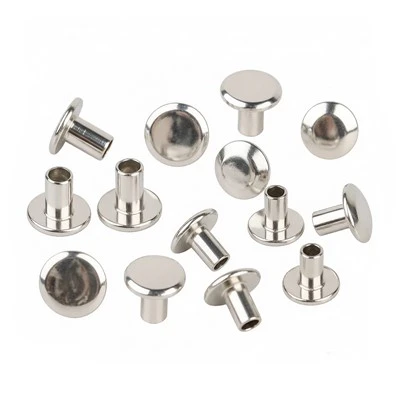
As a type of hollow fastener, tubular rivets are widely used in sectors such as luggage, furniture, and automotive manufacturing. They function by expanding the rivet body under tension to securely join two or more sheets of material; the process is simple and requires no drilling or welding. Since specification requirements vary significantly depending on the application, understanding key parameters is essential for selecting the right rivet.
Key Specification Parameters for Tubular Rivets
Tubular rivet specifications are primarily defined by parameters such as diameter, length, material, and head type, as detailed below:
1. Diameter (D)
This refers to the outer diameter of the rivet body, typically ranging from 2mm to 12mm (refer to *Rivet Technical Specifications, 2024 Edition*). Smaller diameters are suitable for joining thin sheets, while larger diameters offer higher load-bearing capacity, making them ideal for thick plates or high-load applications. Examples include: Φ2–5mm for luggage, Φ4–8mm for furniture, and Φ5–10mm for automotive components.
2. Length (L)
This includes both the body length and the head height, with a typical total length of 5mm to 30mm. Selection depends on the total thickness of the sheets being joined; it is recommended that the body length exceed the total sheet thickness by 2–5mm to allow space for expansion. For instance, when joining two 3mm-thick sheets, an 8mm length (5mm body + 3mm head) might be chosen.
3. Material
Common materials include low-carbon steel (iron), stainless steel (304/316), and aluminum alloy. Low-carbon steel is cost-effective and suitable for standard luggage and furniture; stainless steel offers corrosion resistance, making it ideal for outdoor equipment; aluminum alloy is lightweight and frequently used in aerospace and electronic equipment.
4. Head Type
Common types include semi-round (round) heads, countersunk (flush) heads, and pan heads. Semi-round heads are aesthetically pleasing and suitable for exposed applications; countersunk heads sit flush, meeting requirements for smooth surfaces (e.g., furniture interiors); pan heads are the most widely used, offering a balance between strength and appearance.
Recommended Specifications for Various Scenarios
Requirements for tubular rivet specifications vary significantly across industries; the following are recommended parameters for typical application scenarios:
1. Luggage and Bag Industry
Small rivets are commonly used, with diameters of 2–5 mm and lengths of 5–15 mm; materials are primarily iron or aluminum alloy. For example, iron rivets with a round head (Φ3 mm × L8 mm) are frequently used to attach handles to 20-inch trolley cases.
2. Furniture Manufacturing
A balance between strength and aesthetics is required; diameters range from 4–8 mm and lengths from 10–25 mm. For panels thicker than 5 mm, stainless steel is the preferred material (e.g., Φ6 mm × L15 mm 304 stainless steel countersunk rivets).
3. Automotive Parts
Diameters range from 5–10 mm and lengths from 15–30 mm; materials include high-strength steel or 304 stainless steel. For instance, stainless steel tubular rivets (Φ6 mm × L20 mm) are commonly used to secure interior door panels.
Selection Considerations
Selection should be based on actual requirements to prevent riveting failure:
1. Panel Thickness Matching: The rivet body length should exceed the total material thickness by 2–5 mm to ensure the gap is filled after expansion.
2. Material Compatibility: When joining different materials, consider coefficients of thermal expansion; using the same material or applying galvanized anti-rust treatment is recommended.
3. Tool Compatibility: The stroke of the riveting tool must match the rivet length; rivets that are too thick or too long may result in an insecure joint.
The above outlines the core specifications and selection criteria for tubular rivets. In practical applications, a comprehensive assessment based on the specific scenario, panel thickness, and aesthetic requirements is necessary to ensure optimal riveting results.