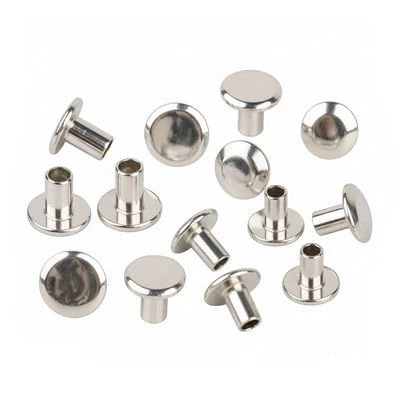
Hollow rivets are commonly used in industries such as apparel and footwear. Derived from the semi-tubular rivet design, the hollow rivet features a hollow bore that extends all the way through to the head; due to their light weight and lower structural strength at the head, they are suitable for riveting non-metallic materials subject to light loads.
There are many types of rivets-categorized by application into hollow, solid, semi-tubular, blind (pop), drive-pin, and others-and regional variations have led to diverse local names. However, specifications should be detailed clearly, including: head shape, diameter, head thickness, shank diameter, length (excluding head thickness), bore diameter, and bore depth. In many cases, bore diameter and depth follow established standards and can be omitted; however, if you lack drawings or images, including these details along with the material type generally allows for direct production.

Hollow rivets are typically used in apparel and footwear. Solid rivets require secondary riveting operations and are used to join heavy components, often creating permanent, non-detachable assemblies. Semi-tubular rivets are the most widely used type; "swaged-end" rivets (with a tapered shank tip) are made from hard wire and can pierce steel sheets up to 0.5mm thick without a pre-drilled hole-without bending or deforming-making them ideal for briefcases, suitcases, and military-grade luggage. Conversely, standard semi-tubular rivets are made from softer wire and must not crack upon clinching; they come in various forms and are increasingly replacing solid pins or two-piece fasteners as axles in toys, significantly reducing production costs. Blind rivets and drive-pin rivets are primarily used for thinner or softer materials; they have less stringent requirements and are typically manufactured from materials with high ductility.